 Native Mojo
Company builder
We build companies on one shared foundation.
Native Mojo starts and backs software companies. Some begin as our ideas, some arrive with a founder — every one of them launches with our capital, our engineers and a technology foundation that took years to build, so it starts years ahead.
One foundation · many companies
The model
How Native Mojo works.
Every company starts with difficult problems that have already been solved. We solved them once, kept the result, and launch companies on top of it — so each venture spends its first year on its business, not its infrastructure.
Independent businesses
Ventures with their own brands, customers and teams — launched here, built on the foundation.
Coordination
Where people, projects, workflows, knowledge and AI meet — across every venture.
The shared foundation
Years of accumulated engineering, hardened in production, inherited by every venture on day one.
Nobody rebuilds the first year
Identity, permissions, data, events, knowledge, publishing and AI are already built — hardened by the companies that came before.
The work is coordinated
People, workflows and AI agents work against the same projects and the same knowledge, from the tools they already use.
Independent by design
Each venture owns its brand, its product and its customers. The foundation stays underneath, where it belongs.
The foundation
Native Mojo Core
Not a product for sale — the accumulated engineering investment behind every company built here. These are the parts of a serious software business that are expensive to build, easy to get wrong, and unwise to improvise.
Enterprise security
Fail-closed permissions on every endpoint, tenant isolation enforced by the framework, encrypted secrets and a structured audit trail.
Identity
Email, passkeys, single sign-on, API keys and service accounts — with hosted, themeable login pages per organization.
Business data
Organizations, members, roles and records, with a REST surface generated from the model rather than hand-written per endpoint.
Organizational knowledge
Documents, handbooks and decisions indexed as vector embeddings, so people and agents search the same source of truth.
Embedded AI assistants
An assistant inside the business application itself, scoped to that organization's data and permitted to act through real tools.
AI agents
Typed agents with defined tools and skills, running on pluggable runtimes and accountable for what they change.
Event & incident intelligence
Events arrive from anywhere, a rule engine correlates them into incidents, and handlers decide what happens next.
Workflow automation
Background work, scheduling, retries and outbound webhooks as first-class infrastructure instead of scattered cron jobs.
Publishing & hosting
Versioned static hosting, custom domains with automatic HTTPS, forms, media and traffic analytics.
Advanced media storage
Direct-to-storage uploads, per-organization quotas and URLs that survive every redeploy and rollback.
Open APIs
Everything the foundation does is available over documented REST and MCP — no capability is locked behind our own interface.
Open-source components
The backend and frontend frameworks underneath the core are public and installable. The floor is not a black box.
Coordination
Maestro
Maestro coordinates work across people, projects, workflows and AI — so what an agent does is visible, reviewable and connected to everything else the organization knows. Every venture here runs on it from its first week.
- Works where your team works. Maestro connects over MCP to the AI tools people already use, instead of asking them to move into another interface.
- Project awareness. Agents see the actual board, the actual code and the actual history — not a pasted summary of it.
- Reusable skills. Compound workflows built from tools, versioned and improved as they are used.
- Shared knowledge. One indexed body of organizational knowledge behind every agent and every person.
- Team collaboration. Boards, milestones, ownership and an activity trail that records what an agent changed and why.
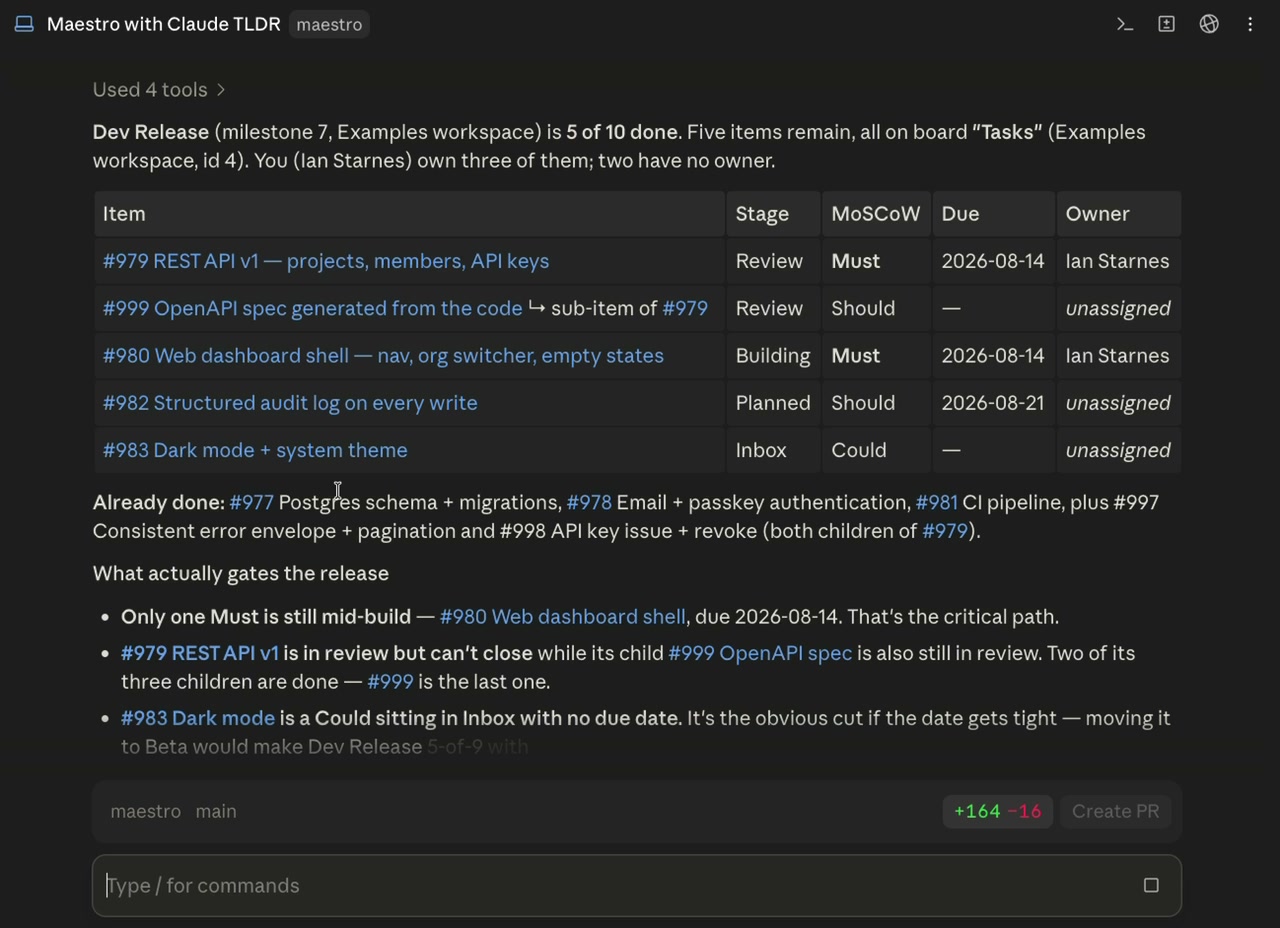
Maestro answering inside the team's own AI tool
Building companies
Two ways a company starts here.
We are not an agency and not a fund with a deck. We put capital, engineers and a working foundation into a small number of companies — and hold a stake in what they become. Both paths have produced operating companies.
Native Ventures
The idea starts here. We validate the opportunity, fund the build, and put our own engineering and marketing teams on it.
When it is real, we recruit an experienced operator who knows the market — with a genuine stake in the company, not a salary and a title — to lead it and grow it.
Founder Ventures
The idea arrives with a founder. We invest capital and put our legal, engineering, business-development and marketing teams behind the company — in exchange for an equity stake.
The founder keeps leading. The company skips the year of infrastructure and goes straight to the part that is actually its own.
Why this model works
Years of engineering, on every cap table.
Every new company here benefits from the accumulated investment of all the ones before it — and stays free to build its own product, brand, customers and identity.
Years ahead on day one
The unglamorous first year — identity, permissions, data, publishing, operations — is already done, in production, before the venture writes its first line.
Aligned, not billed
We take equity, not fees. The capital, the engineers and the foundation all point at the same outcome the founder wants.
Every venture hardens the next
Problems found in one company's production become fixes in the foundation that every other company inherits.
Independent by design
Each company owns its brand, its product and its customers. The shared technology stays invisible underneath it.
Get in touch
Have an idea that should exist?
Tell us about the problem and the market. If it is a fit, we bring the capital, the engineers and the foundation — and build the company with you.